
The Difference Between Being an Empath and Practicing Empathy

For most of my life, I thought being a strong empath was a superpower. And in some ways, it was.
I could walk into a room and read it before I sat down. I caught micro-expressions. I felt the temperature shift before anyone said a word. I knew when someone was uncomfortable even when they were performing perfectly fine. And without thinking about it, I would start adjusting. Softening the air. Smoothing things over. Keeping the emotional center of whatever group I was in from tipping into chaos.
What I did not realize, for a long time, is that this was not empathy in practice. It was hypervigilance in disguise.
Being an empath and practicing empathy are not the same thing.
An empath scans the environment. A person practicing empathy asks about it.
An empath manages how other people feel, sometimes without their knowledge much less consent. A person practicing empathy creates space for others to notice and name what they feel themselves.
The difference matters because one of those is about them. The other is mostly about you.
For me it was a coping mechanism I developed early, and it served a purpose. If I could sense what someone needed before they asked, I could get ahead of the disruption. I could keep things safe. I was not only doing it just for their protection. I was doing it for mine.
That is the part that took me longer to admit to.
The reason I am writing about this now is that I see it show up in workplaces a lot. And it is almost never labeled for what it is.
When it is appreciated it gets called being a “team player.” A “culture carrier.” Someone who makes the office feel welcoming and warm. Women in particular get praised for it. Low-status team members get expected to perform it without ever being asked. And the person doing it is often running an invisible process in the background: reading the room, regulating the mood, making sure the emotional infrastructure holds.
That is labor. And it can be exhausting precisely because it never stops and is rarely acknowledged.
Here is what I want for any community I facilitate: I do not want to be the person running that process. And I do not want to inadvertently require other people to run it.
What I want instead is to give people actual tools.
A Regulation Framework
So here is one.
I came across a polyvagal Venn diagram recently that stopped me. You have probably seen versions of the polyvagal theory before. Stephen Porges developed it, and it has become a foundational framework in trauma and nervous system work. But this diagram laid it out in a way that clicked for me differently.
Three systems. Three circles. And where they overlap is where things get interesting.
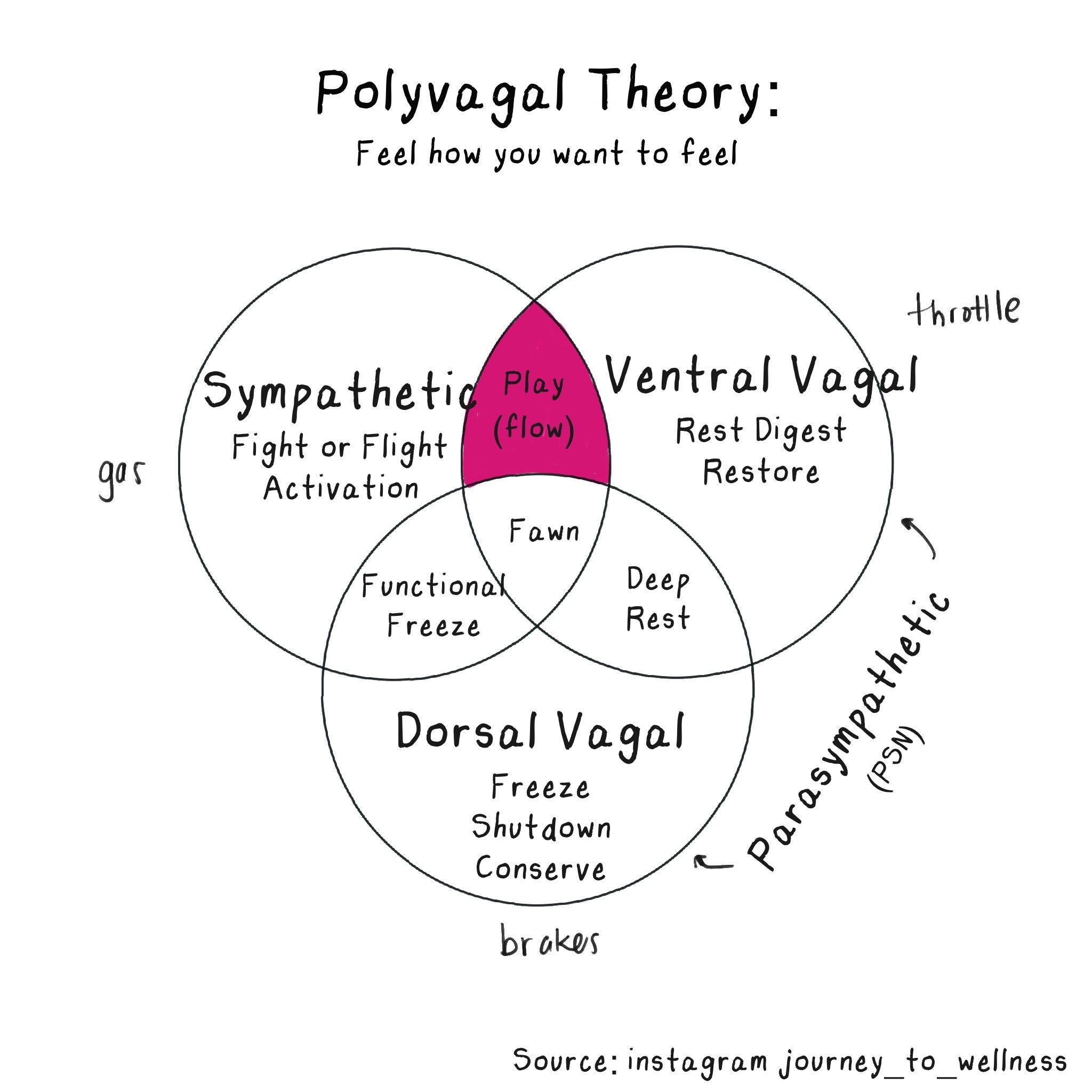
The sympathetic system is your fight-or-flight activation. Gas pedal. This is the system firing when you are on deadline, when there is conflict in the room, when something feels threatening. Energy up, focus narrow.
The dorsal vagal system is the brake. Freeze, shutdown, conserve. This is the system that takes you offline when a threat feels inescapable. Dissociation, collapse, checking out.
The ventral vagal system is rest, digest, restore. This is the system that says you are safe. You can receive. You can connect.
Polyvagal and Flow
Now here is the part that matters for how we work together and why friction happens.
In the overlap between sympathetic and ventral vagal, you find Play, Creativity, Insight. This is where I want to spend most of my time. It is activated, but not threatened. Engaged, but connected. There is energy and there is safety at the same time. For those of you who have read Applied Flow, you know this is exactly what we are talking about when we talk about flow states: not relaxation, but challenge and support in balance.
In the overlap between sympathetic and dorsal vagal, you find Functional Freeze. The appearance of doing fine, but nothing is actually moving - people feel stuck and frustrated.
In the overlap between ventral vagal and dorsal vagal, you find Deep Rest. Recovery. The nervous system settling.
And in the center, where all three overlap, you find Fawn. The appeasement response. Keep everyone comfortable, smooth things over, manage the room. Sound familiar?
This is what I was doing. For years. Living in the fawn zone and calling it empathy.
The reason I find this framework useful beyond neuroscience is that it makes visible something that is usually invisible. When you and a teammate are at friction, it often feels like a conflict of values. It can feel like they do not care, or you do not matter, or someone is being unreasonable. But sometimes it is a mechanical issue. One person’s nervous system is pushing for play. The other is pushing for rest. Each seeking to cope either stressors in their own way. Neither one is wrong. They are just not in the same state, and they do not have language for it.
That is not a character flaw. It is a mismatch in activation level.
And once you can name it, you have options you did not have before. You can say: I think I need to downregulate before we make this decision. You can say: I notice I am chasing a lot of energy right now and you seem to need something quieter. You can say: I am in freeze or overwhelmed and I need help getting back online before I can contribute.
That is not emotional labor. That is self-regulation. There is a difference.
Co-regulation is a Gift
Co-regulation is real and natural and often beautiful. We do it unconsciously with people we trust. But it becomes a problem when it is expected of one person, invisible, and never reciprocated.
The goal I am working toward, in my own facilitation work and in JJM, is to hand people the map. To give them enough language to name what is happening in their own nervous system so that they stop waiting for someone else to manage it for them.
Play is available to you. Flow is available to you. But no one else can put you there. They can help. We can co-create conditions. We can stop making it harder. But the navigation is yours.
What state are you in right now? And is it the one you want to be in?
I would genuinely love to know.
Heather C. Ingram is the author of Applied Flow: Stop Burnout. Be Awesome. and the founder of the Job Journal Method. Generous Confidence publishes weekly on workplace wellbeing, self-knowledge, and the strategies generous people use to stay whole.